Rahu and Ketu: The Karmic Shadow Planets Explained
Rahu and Ketu are not physical bodies — they are mathematical points where the Moon's orbit crosses the ecliptic. But in Vedic astrology they carry profound karmic weight, shaping obsession, liberation, and life's deepest lessons.
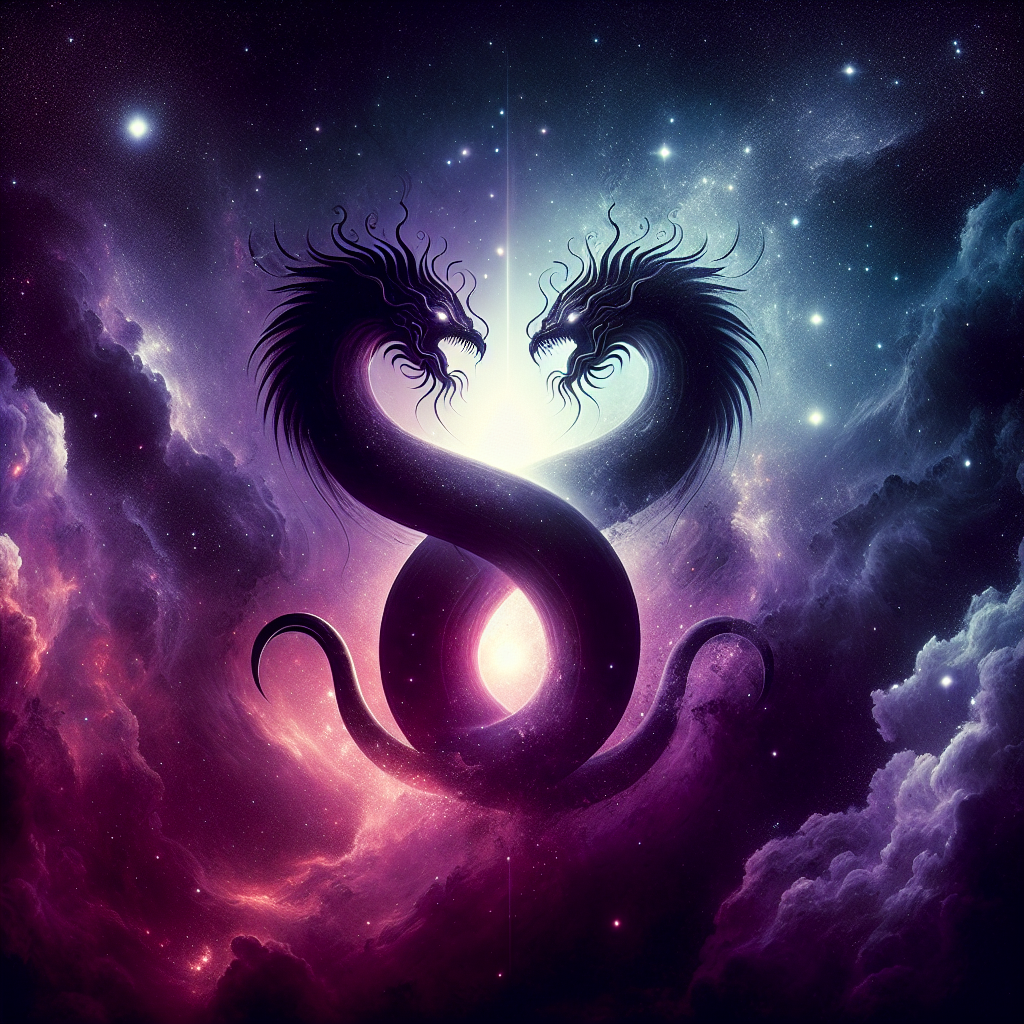
Among the nine Grahas of Vedic astrology, two are not planets at all. Rahu and Ketu are mathematical points — the lunar nodes, where the Moon's orbit around the Earth crosses the Earth's orbit around the Sun. They are invisible. They emit no light. But no other planetary forces in Vedic astrology carry more karmic weight, more power to make or unmake a life, than these two shadow points.
The astronomical reality
The Moon's orbit is tilted about 5 degrees from the plane of the Earth's orbit (the ecliptic). The Moon crosses the ecliptic twice per orbit — once going north, once going south. These two crossing points are the north node (Rahu) and the south node (Ketu). They are always exactly 180 degrees apart. They are where solar and lunar eclipses occur — whenever the Sun and Moon align close to a node, an eclipse is possible.
This is significant. The nodes are the devourers of light — the only points where the two luminaries of the sky can be swallowed. Vedic tradition recognized this thousands of years ago and encoded it into mythology.
The myth of Rahu and Ketu
According to Hindu mythology, during the churning of the cosmic ocean, the gods and demons produced amrita — the nectar of immortality. The gods were drinking it when a demon named Svarbhanu disguised himself as a god and took a sip. The Sun and Moon recognized him and warned Vishnu, who cut off the demon's head with his discus. But Svarbhanu had already swallowed the nectar. His head became immortal as Rahu, and his body became immortal as Ketu. To this day Rahu and Ketu pursue the Sun and Moon for revenge, occasionally swallowing them — which is what we observe as eclipses.
This myth encodes the psychology of the nodes: Rahu is endless appetite without a body to contain it; Ketu is disembodied wisdom without a head to direct it.
Rahu: the planet of obsession and outsider ambition
Rahu represents unconscious desire, obsession, foreign territory, technology, fame, and the hunger to rise beyond one's origins. It is the planet of immigrants who succeed abroad, outsiders who break into establishments, disruptors who reshape industries, and celebrities who rise from nowhere.
A well-placed Rahu can produce dramatic worldly success — Olympic medals, Oscar wins, overnight fortunes, breakthrough scientific discoveries. A poorly-placed Rahu produces obsession without fulfillment: working relentlessly for an empty goal, chasing a lifestyle that never feels like "arrived," addictions to substances or activities that substitute for genuine satisfaction.
Rahu shows you where you are insatiable. Whatever house Rahu sits in will be an area you pursue with disproportionate hunger, often convinced that just one more achievement will finally feel like enough.
Ketu: the planet of detachment and past-life mastery
Ketu represents detachment, moksha (spiritual liberation), past-life skill, sudden loss, occult knowledge, and headless wisdom. Where Rahu is head without body, Ketu is body without head — instinctive competence without conscious desire.
Whatever house Ketu occupies will be an area where you have unusual natural skill — but paradoxically, less drive to use it. The area feels "already done," as if you completed its lessons in a previous life and came into this one with the skill pre-installed but the interest drained. Many people with Ketu in the 10th house (career) have remarkable professional competence but feel vaguely uninspired by their career, wondering why others find it so gripping.
Ketu also signifies sudden losses — things that disappear not through your fault but because the universe is clearing space for the next chapter. These losses often relate to whatever you no longer need.
The Rahu–Ketu axis
Rahu and Ketu are always exactly opposite each other in the zodiac. This means they form an axis that cuts through your chart along two specific houses. That axis is the central karmic spine of your life.
- Ketu house — where you are already mastered, where the past life left you fluent, where you can perform without trying but feel little spark.
- Rahu house — where you are a beginner in this lifetime, where you must stumble, fail, and push beyond your comfort zone. This is the karmic direction of growth.
The instinct is to stay in the Ketu house — it is familiar and effortless. But life's real development lies in moving energy toward the Rahu house. Someone with Ketu in the 1st and Rahu in the 7th, for example, has a past-life pattern of self-sufficiency and a current-life assignment to learn relationship, partnership, and consultation.
Rahu in each house — a quick tour
- 1st house — unconventional identity, foreign influence on self-image, obsession with self-development.
- 2nd house — hunger for wealth, unconventional income, issues with family and speech.
- 3rd house — bold communication, travel, sibling dynamics, ambitious writing or media.
- 4th house — restlessness about home, foreign lands, unconventional domestic situation.
- 5th house — speculative risk, obsession with creative recognition, complicated romance.
- 6th house — obsession with enemies, health, service; can be one of Rahu's most productive placements because it "wins" over conflict.
- 7th house — unconventional marriage, foreign partner, obsessive partnerships.
- 8th house — occult obsession, research, sudden transformations, sometimes scandal.
- 9th house — foreign teachers, unconventional spirituality, ambitious philosophy.
- 10th house — career obsession, fame, public ambition, foreign career. Often very productive.
- 11th house — networks, large gains, ambitious friendships. Another of Rahu's favored placements.
- 12th house — spiritual obsession, foreign residence, hidden obsessions, loss and liberation entangled.
Ketu in each house — the mirror
Ketu's placement is always 180 degrees away. If Rahu is in the 1st, Ketu is in the 7th; if Rahu is in the 3rd, Ketu is in the 9th. Wherever Rahu drives ambition, Ketu on the opposite side dissolves attachment. A person with Rahu in the 10th and Ketu in the 4th may have enormous career ambition but feel strangely disconnected from home and mother-themes — they have already completed that lesson.
The 18-year Rahu Mahadasha
Rahu's Mahadasha lasts 18 years — the second-longest of any Graha. It is the most dramatically variable of all Dashas. Depending on Rahu's placement in the chart, these 18 years can produce explosive worldly success, prolonged confusion and addiction, foreign relocation, or complete reinvention of identity.
The best Rahu Dashas fall on people with well-placed, strong, benefic-influenced Rahu in houses like the 3rd, 6th, 10th, or 11th. The hardest Rahu Dashas fall on people with afflicted Rahu in houses like the 2nd, 8th, or 12th — where its hunger turns inward and becomes obsession without outlet.
The 7-year Ketu Mahadasha
Ketu's Mahadasha is shorter — just 7 years — but can be equally transformative. Ketu Dashas often bring endings: a job ends, a relationship ends, a location is left behind, a phase of life closes. The Dasha rewards those who let go and punishes those who cling. It is one of the most spiritually productive Dashas if met with acceptance.
Eclipses and the nodes
Because Rahu and Ketu are the eclipse points, solar and lunar eclipses are their most intense active moments. An eclipse near your natal Rahu or Ketu position can mark a major karmic pivot — a sudden relationship change, a job loss, a spiritual awakening, a geographical move. Eclipse periods are traditionally not used for beginnings; they are used for release, meditation, and observing what the universe is taking away.
Remedies
- Rahu — chant Om Rahave Namah or the longer Rahu Beej Mantra; wear hessonite garnet (Gomed) if prescribed; donate on Saturdays; feed the poor on Wednesday evenings; work with unconventional or outsider communities as service.
- Ketu — chant Om Ketave Namah; wear cat's eye (Lehsunia) if prescribed; visit temples quietly and alone; practice meditation, fasting, and spiritual study; donate gray or multicolor cloth on Tuesdays.
- Shared — the most powerful general remedy for either node is the practice of Sade Sati-style surrender: accepting that this chapter of life is a karmic lesson and orienting toward it with humility rather than resistance.
The deeper teaching
The nodes are the axis of your karma. Whatever you refused to learn in a previous lifetime — whatever you fled from, rejected, or left unfinished — Rahu pulls you toward it now, relentlessly, whether you consciously want it or not. Whatever you mastered to the point of boredom, Ketu quietly puts behind you.
If you are in a chapter of life that feels disproportionately obsessive, uncomfortably new, or strangely important out of all proportion to its objective stakes — check where Rahu is transiting in your chart. The universe is asking you to grow in exactly that direction.
The nodes are not cruel. They are insistent. They are the sky's way of making sure you do not leave this lifetime with the same unfinished lessons you entered with.